10 Wood Wall Decor Ideas Interior Designers Actually Use
Wood wall decor works best when it does more than decorate — when it organises space, anchors a composition, balances furniture, and adds texture. Below are ten techniques that actually appear in real interiors.
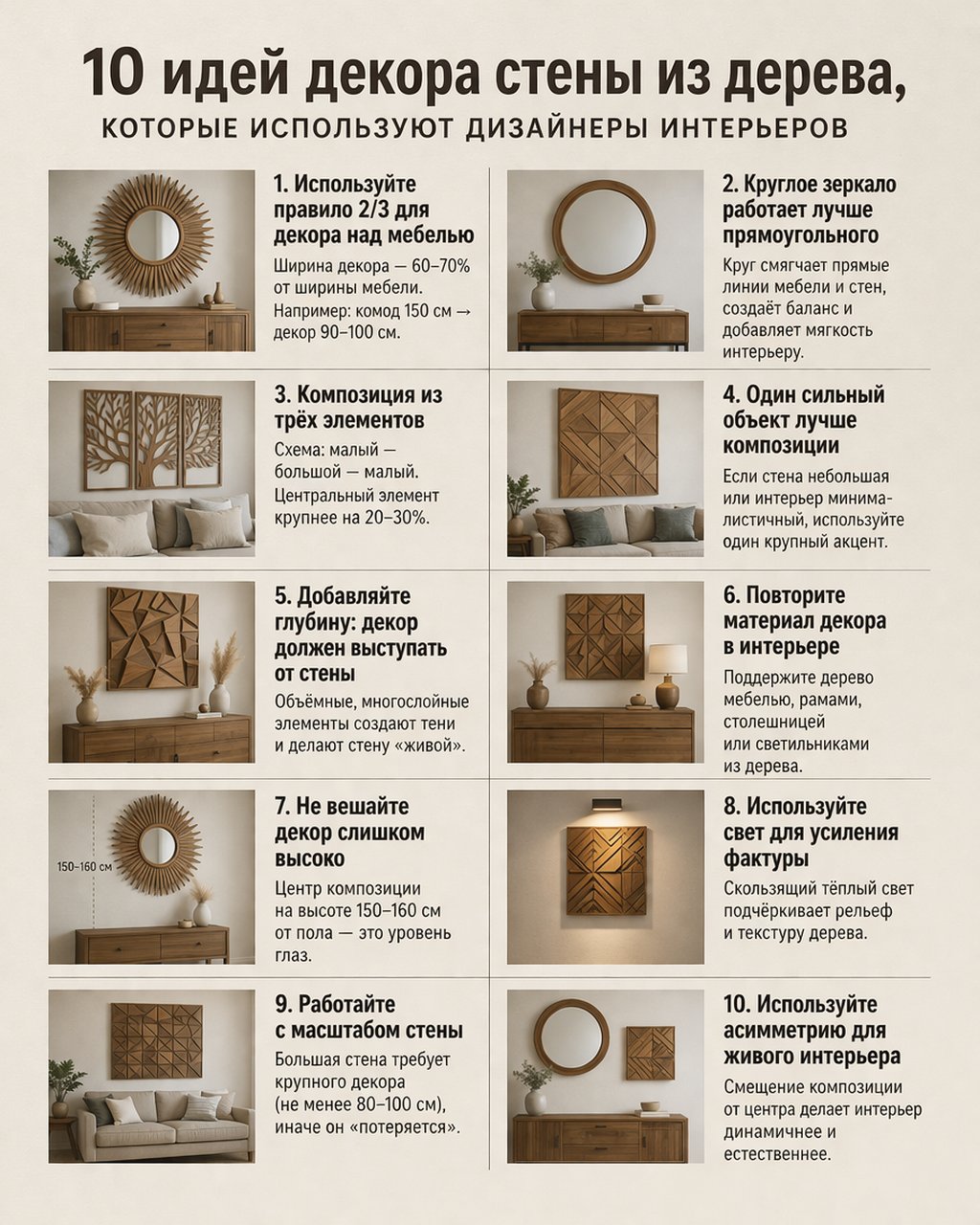
When placing decor above a console, dresser, sofa or sideboard, the width of the composition should be around 60–70% of the furniture width. A 150 cm dresser means decor of roughly 90–100 cm. Anything smaller makes the wall look empty regardless of what is on it.
Against the straight lines of furniture and walls, circular forms create balance. That is why designers regularly choose round mirrors, radial compositions and circular panels — they soften the geometry of a room and introduce movement where it is missing.
If a single piece feels too simple, work in threes: three panels, three decorative forms, three small mirrors. The central piece should be 20–30% larger than the flanking ones. The pattern small–large–small works in almost any interior.
In a minimal interior or on a smaller wall, one expressive piece does more than a group. A large mirror, a bold decorative panel, or a strong geometric form creates a clear focal point and makes the interior feel calmer and more expensive.
Flat decor often looks cheap — it lacks shadow and volume. Pieces with thickness, layering and relief read better. Multilayer panels, carving with several depth levels, geometric forms that cast shadows — this kind of wall looks alive.
Wood on the wall needs to be supported by other wooden elements: furniture legs, a mirror frame, a tabletop, a lamp. If wood appears only in one spot, it reads as an accident rather than a considered decision.
The most common mistake. The centre of the composition should sit at around 150–160 cm from the floor — eye level. Any higher and the gaze cannot reach it comfortably: the wall feels empty at the bottom and the decor disappears toward the ceiling.
Wood surface looks especially good under raking light — it creates shadow in the relief and makes texture visible. A wall sconce, downlight from above, or warm directional spot will multiply the impact of any wood decor on the wall.
A large empty wall needs a large piece. A 3-metre wall needs decor of at least 80–100 cm. A small piece on a large wall does not create an accent — it gets lost. The reverse is also true: oversized decor on a small wall overwhelms the space.
Strict symmetry reads as formal and can feel static. An asymmetric arrangement — mirror left, panel right, a small piece below — looks more alive and contemporary. This is not randomness: asymmetry follows its own rules, but visual balance is achieved differently.
Mistakes that almost always spoil a wall
- Decor too small relative to the furniture and wall
- Random placement with no shared axis or logic
- No visual centre — the eye has nowhere to land
- Hanging too high — decor falls out of comfortable sightlines
- Too many small objects with no unifying anchor